Thursday, October 22, 2015

The Battle of Frontenard - October 16, 1745 - the battle fought

I embarked on another fine trip to Chez Bairos last Friday evening for another installment of our ongoing ImagiNations campaign. A note about the structure of this campaign may be in order. Although we have a map of the ImagiNation world in which we play, we did not start a traditionally structured campaign with map moves and logistics etc. Rather, I think of it as a narrative campaign. It started with choosing one of C.S. Grant's TableTop Teasers, a series of gaming scenarios published in various magazines and books. The first battle of the campaign, The Battle of Lugio, was based mainly on Teaser 8 from Battlegames Tabletop Teasers Vol 1. After the game, we talked about what would happen next in the narrative and decided that the loser (in this case, Gourmandie) would fall back to the Cabrera River and there would ensue some sort of forced river crossing scenario. I once again scoured the available TableTop teasers and other scenario collections and found one that eventually became The Bridge at Petit Montagnac. The next battle followed a similar process, and so on...until we reached The Battle of Frontenard.I embellish the scenario description to fit our campaign context and Voila! ... narrative campaigning. 

For a full description of The Battle of Frontenard, go here. To avoid duplication, the basics of the game were an aggressive Libagioni move into Gourmandie territory confronted with a well-entrenched but numerically inferior Gourmandie army, again under the command of Le Marquis de Fromage.


First up some shots of the initial dispositions of the armies outside Frontenard. Unfortunately, I forgot my 4x6 light green gaming mat that matches Vidal's and we were forced to use a darker 8x5 cloth. I prefer the lighter green for the ImagiNation games because I think it brings out the colours of the figures much better. Ah, well. C'est la vie.

View from the left rear of the Libagioni army, with the outskirts of Frontenard at the top of the photo and the Gourmandie entrenchments across the top left. The Libagioni army L-R: cavalry brigade, Libagioni infantry brigade, KaiserReich infantry brigade, independent light troops.

View from the right rear of the Gourmandie army.

Gourmandie grenadiers holding the foremost buildings in Frontenard.

Gourmandie artillery and infantry defending the entrenchments. This is the wonderful sectional model I picked up at Historicon this year from Architects of War. I had just finished painting and flocking this the evening before the game and, truth be told, was the incentive for the scenario. I really just wanted to put it on the table and see it filled with troops. The scenario was secondary.

Another shot of the earthworks from the front. The entire piece is about 40 inches long, made of six separate pieces which can be deployed in various configurations as part of the whole or separately. In this photo you can see why we wanted to use the lighter green mats. The flocking on the earthwork pieces was meant to match the mats. Oh well...

The battle began with a "large" (can't quite say "massive" yet but soon) cavalry melee on the Gourmandie right flank, as all proper eighteenth century battles should begin.

The brand new Ulanen Hasseroder, a portion of the KaiserReich contingent serving with the Libagioni army, take on Gourmandie Grenadiers a Cheval Boursin. The KaiserReich cavalry are a 16-figure unit, thus "standard" size in Black Powder. Vidal chose to field the three 8-figure Boursin squadrons as separate "small" units rather than a larger whole. Each of these "small" units suffer a -2 Hand to Hand penalty but this is more than made up for by their initial 9 HtH rating, the Heavy Cavalry +1 combat result modifier, and their elite status. Facing them were Ulanen Hasseroder with a HtH rating of 6 (thus already lower than the Boursin 7) but with the lancer bonus in the first round of combat. It was an entertaining rumble.

Meanwhile, in the center of the field...

The Libagioni infantry launch themselves at the earthworks. I chose not to waste time and rolled for a charge order on the first turn, even though I needed a three-move result. Luckily, I rolled just that and the green horde swept across the field and crashed against the earthworks. "Against" is the operative word here. Although they were able to push one Gourmandie battalion back momentarily, they never were able to cross over the massive obstacle. And why an immediate headlong charge? Libagioni infantry do not have the First Fire characteristic but they do have Terrifying Charge and Bloodthirsty. Thus, no sense getting into a firefight with the well-protected defenders. Rather, it seemed a good chance that one or more of the defending units would fail the Break Tests dictated by the Terrifying Charge rule and leave their comfortable perch upon the earthworks. Unfortunately for Il Prinicipe Martellato and his loyal regiments, the Gourmandie defenders held firm. It was then just a matter of time before the Libagioni infantry were forced to retire in the face of disciplined Gourmandie musketry.
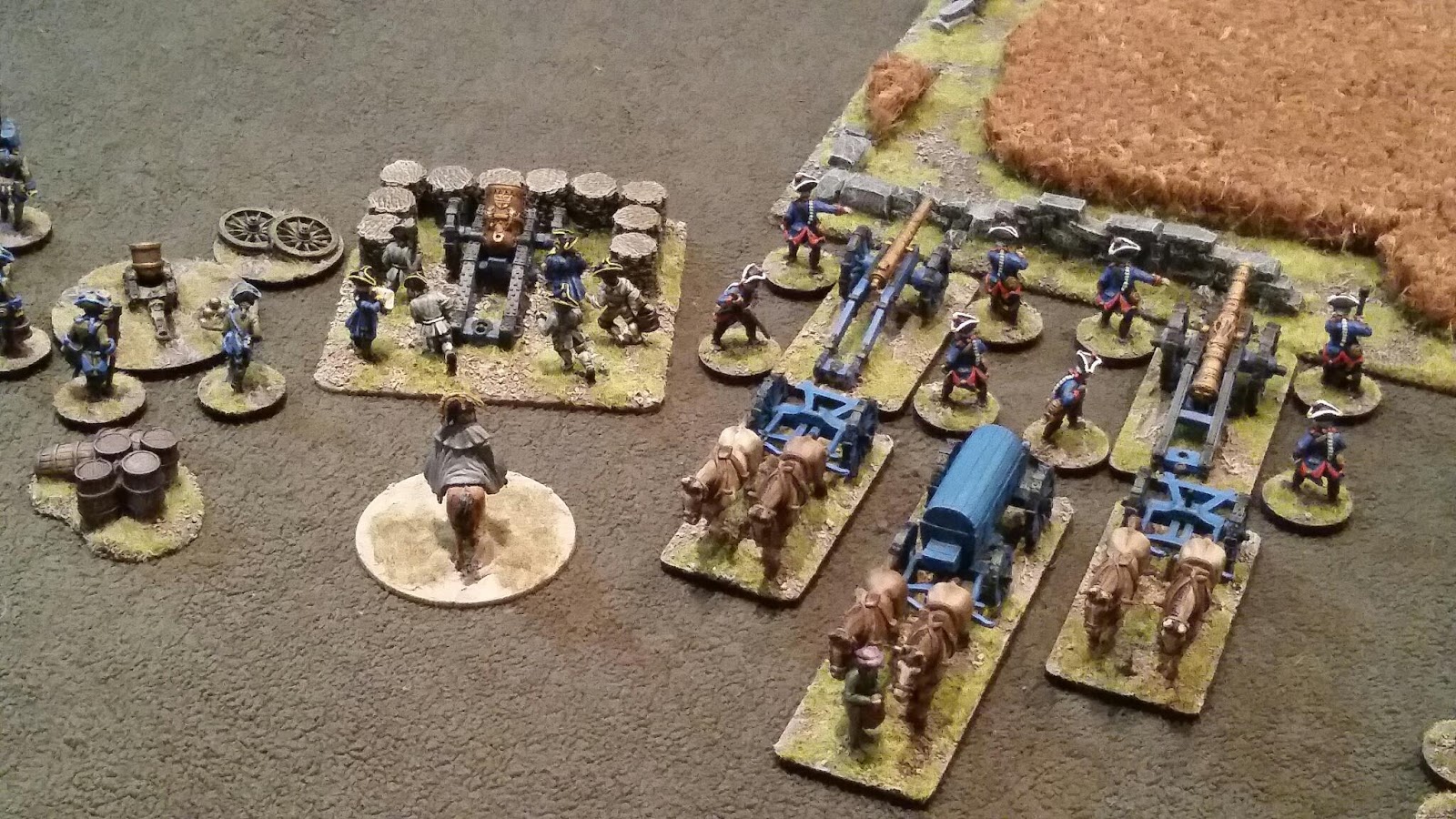
The Libagioni - KaiserReich artillery park. They had little effect in the game save to add immeasurably to the aesthetic effect. As in golf, as it is in this ImagiNation world: "It's not how you play, it's how you look when you play."

An utter failure against the Gourmandie entrenchments, an inconclusive cavalry battle, and a less than enthusiastically executed attack on Frontenard itself by the Kaiserreich contingent has forced Il Prinicipe Martellato  to concede at least temporary defeat in his attempt to wrest territory away from Gourmandie. Of more immediate and pressing concern is the reaction of KronPrinz Friedrich Wilhelm to the Libagioni failure. Will the KaiserReich contingent be recalled? Meanwhile, the Libagioni army limps back to the frontier.


Thursday, October 15, 2015

The Battle for Frontenard - October 16, 1745 - scenario notes

Flush with success at forcing a crossing of the Lower Cabrera at Petit Montagnac, Il Prinicipe Martellato pushes onto the southeast toward Frontenard. With this move he hopes to cut off the border fortress of Champaigne from communication with and succour from the bulk of Gourmandie territory to the west. Martellato also knows that his fragile alliance with KronPronz Friedrich Wilhelm could at any time devolve into a purely business arrangement (more so than it already is) and the KaiserReich ruler could quickly demand the return of his troops marching with the Libagioni army.


Unfortunately for Martellato, when his columns pull close to Frontenard and shake themselves out into battle order, he sees through the morning mist that the Gourmandie army has not been idle in the weeks following the crossing of the Cabrera. Before Martellato's eyes and spanning the plain to the east of Frontenard are substantial earthworks and artillery emplacements!


However, in Martellato's favour... he enjoys a substantial numerical superiority. A number of units have joined his field army since the last encounter with Gourmandie, including the newly raised Ulanen Hasseroder from Das KaiserReich as well as Libagioni siege artillery.


Defending Frontenac, the Gourmanide army again enjoys the presence of Le Marquis de Fromage and the most redoubtable Arch-Bishop Ambroise de Chabichou du Poitou. Le Marquis is fresh from the recent marriage of his eldest son Michel-Davide, Comte d'Auvergne and is in fine fighting spirit, despite the daunting odds before him.


The Libagioni army need only oust le Marquis from Frontenard to effect the isolation of the fortress of Champaigne. Martellato can then decide to invest the fortress or move farther south into the heart of Gourmandie.

Sunday, September 27, 2015

The Bridge at Petit Montagnac - September 25, 1745 - the battle fought

Friday saw the latest battle in the struggle between Gourmandie and Libagioni. Vidal and I welcomed Dan to the table and set about the game. Vidal once again assumed the mantle of Gourmandie command, this time in the form of le Comte de Boursin (in the absence of le Marquis de Fromage). Dan would command the Libagioni army of Il Prinicipe Martellato (with a little help from his KaiserReich allies).

The Bridge at Petit Montagnac - September 25, 1745


Following his loss at Lugio in August, Le Marquis de Fromage withdrew his battered force south to the Cabrera River, the border between Gourmandie and Libagioni. Expecting immediate pursuit, le Marquis left a small holding force at the three bridges in the village of Petit Montagnac, while he hurried to the capital to bring more troops to the frontier. Unbeknownst to him, his haste was unnecessary. Il Prinicipe Giuseppe Martellato, commander of the Libagioni army, had relied heavily on KaiserReich troops for his victory at Lugio. Following that action, representatives of KronPrinz Friedrich Wilhelm had arrived at Martellato’s field camp, demanding the return of the loaned troops. Many weeks went by as Il Principe negotiated terms with the KaiserReich ambassadors to maintain their troops with the Libagioni army. It was good fortune for Gourmandie, as most of the army was on the western frontier, carefully observing the political unrest in St Julien. The garrison at Petit Montagnac was thus lulled and forgotten for a time. No new orders had arrived from le Marquis and the garrison commander, Georges leRoque, Comte de Boursin, was determined to fulfil his orders to defend the river crossings.


Orders of Battle: link

As soon as the Gourmandie forces were laid out on the table, it became apparent that le Comte de Boursin would have some command challenges. The infantry brigade commanded by le Comte de Roquefort had units spread across the north edge of Petit Montagnac and the reserve battalion to the south of the village. The cavalry and artillery were under Boursin's direct command and suffered a similar dispersed deployment. Boursin was clearly not expecting the Libagioni attack. 

View form the north-west of Petit Montagnac. The River Cabrera bisects the field from south-west to north-east. The village and its bridges form a bottleneck for the attacking Libagioni forces attempting any crossing of the river (unfortunately, I forgot my tripod so most of the pictures are not of the best quality).

View from the south of the village, showing Roquefort's reserve battalion and the artillery guarding the central bridge.

The Libagioni advance guard cavalry quickly entered the field from the north-west, under Dan's command, and promptly moved against the isolated Gourmandie cavalry. These were chased off handily by the Grenadiers a Cheval Boursin (elite heavy cavalry vs run-of-the-mill dragoons wasn't really a fair fight anyway). Of course, a blunder on the part of the Libagioni cavalry commander didn't help....throwing shaken Libagioni dragoons forward at the Gourmandie heavies.

The Libagioni cavalry can be seen at the top of the photo, preparing to move against the Gourmandie heavy cavalry guarding the bridges. 

Boursin realized that this cavalry attack was just an advance guard and that his troops north of the river were too isolated and dispersed to mount an effective defence against any determined attack from the expected Libagioni main body. He determined at this point that the best manner in which to guard the crossings was to move south of the river and block the bridges. This would force the Libagioni forces into the bottleneck where the Gourmandie musketry and artillery could best show its effect. He began moving his infantry and cavalry back to the bridge, preparing to cross when Prinicipe Martellato's main Libagioni force began to arrive, in the form of a KaiserReich infantry brigade and the remainder of the cavalry.

The KaiserReich infantry deploys, grenadiers to the right. Boursin had managed to get his infantry on both flanks back across the river. One isolated heavy cavalry unit was caught, however (on the extreme left of the photo). 

Multiple command failures ensured the Gourmandie heavy cavalry on Bourisn's right flank would face a number of volleys from the advancing KaiserReich infantry. The cavalry was forced back to the river where it was eventually broken. 

It was at this point that a dust-stained and sweating rider appeared before le Comte de Boursin, with the following missive:

Sauvergny September 23, 1745

Monsieur le Comte,
Le Marquis has advised me to inform you of the latest intelligence emanating from Il Ducato di Libagioni. After le Marquis’ unfortunate reversal at Lugio in August, Prinicipe Martellato has not been idle. Reports have reached le Marquis that a number of KaiserReich contingents have marched to His Highness’ aid and now, in conjunction with His Highness’ own Libagioni legions, are marching south to the Cabrera. Le Marquis is even now marching to your assistance with the bulk of the Gourmandie army and has determined that you must delay the Libagioni army only insofar as it will not seriously jeopardize the integrity of your force at Petit Montagnac. If you determine that holding the crossings of the Cabrera is in any way inadvisable for the continued welfare of your command, you must, with all haste and alacrity, following the dictates of your judgement, withdraw south of the river toward Montagnac. If, however, you are in a position to conclude that the continued existence of your force north of the Cabrera is tenable, and indeed in the keeping of Le Marquis’ present desire that the enemy be rewarded in kind for their ignominious and unexpected victory at Lugio, you must, with the utmost earnest, remain with your force thus, and attempt to extract the maximum advantage of the situation. Otherwise, and with Le Marquis’ abundant approbation and approval, you have his permission to withdraw to the south bank of the river to continue your defence of the town.

With the greatest respect, I am your humble servant

Jean-Jacques Sommelier

Chief of Staff to His Lordship, Le Marquis de Fromage

This rather ambiguous letter caused some consternation for Boursin. Was he to hold the bridges or not? Luckily, he had not abandoned the defence and was still in a good position to fulfill his admittedly confusing orders.

Martellato proceeded to move the KaiserReich infantry to the bridges to face the defending Roquefort battalions. Fire-fights ensued over both outer bridges, Martellato hoping to weaken the defenders before sending in his fearsome Libagioni infantry which had arrived and moved up behind their KaiserReich allies. Libagioni infantry have the bloodthirsty and terrifying charge characteristics but lack any fire discipline and thus do not  get the first fire bonus. This made them ideal for the attack that Martellato was carefully setting up. Unfortunately, a wrench was thrown into this seemingly well executed plan (as seems always to happen at this point). The KaiserReich grenadiers on the right flank inexplicably got the worst of the fire-fight and failed a Break Test. The following Libagioni infantry were left to face a relatively unscathed Roquefort battalion, backed up by the Gourmandie artillery at the centre bridge.

Gourmandie artillery at the centre bridge.

To make matters worse for Martellato, the sun was now quickly falling and evening was approaching. His right flank units frantically searched for a ford by which to flank the Gourmandie defenders, to no avail. As the sun finally dipped below the horizon, a final charge by Libagioni infantry on the left flank finally succeeded in gaining a foothold on the south bank. Night had fallen and Il Prinicipe had fulfilled his objective, although only barely ("If Martellato with his Libagioni forces has command of and access by at least one bridge from one side of the river to the other, such that reinforcements may cross to the south bank by night, regardless of the state of the other bridges, then he has won the game, achieving his objective.")

Having gained a foothold on the south bank, Martellato can mass his army overnight in Gourmandie territory. But to what purpose?

Thanks again to Vidal for hosting and to Dan for taking on the Libagioni command. A fun game all 'round!

Tuesday, September 22, 2015

The Bridge at Petit Montagnac - September 25, 1745 - scenario notes

Another ImagiNations scenario in preparation for Friday gaming at Chez Vidal. This scenario is derived from C.S. Grant's Tabletop Teaser "Key Point", originally published in the April 1980 edition of Military Modelling.

The Bridge at Petit Montagnac - September 25, 1745

Following his loss at Lugio in August, Le Marquis de Fromage withdrew his battered force south to the Cabrera River, the border between Gourmandie and Libagioni. Expecting immediate pursuit, le Marquis left a small holding force at the three bridges in the village of Petit Montagnac, while he hurried to the capital to bring more troops to the frontier. Unbeknownst to him, his haste was unnecessary. Il Prinicipe Giuseppe Martellato, commander of the Libagioni army, had relied heavily on KaiserReich troops for his victory at Lugio. Following that action, representatives of KronPrinz Friedrich Wilhelm had arrived at Martellato’s field camp, demanding the return of the loaned troops. Many weeks went by as Il Principe negotiated terms with the KaiserReich ambassadors to maintain their troops with the Libagioni army. It was good fortune for Gourmandie, as most of the army was on the western frontier, carefully observing the political unrest in St Julien. The garrison at Petit Montagnac was thus lulled and forgotten for a time. No new orders had arrived from le Marquis and the garrison commander, Georges leRoque, Comte de Boursin, was determined to fulfil his orders to defend the river crossings.


Terrain
The river, which flows from the east to west, is spanned by three low stone bridges. These bridges have low walls but do not provide cover from fire. The buildings of Petit Montagnac are stone structures. Apart from the bridges, the river is possibly fordable in places. 


Le Grand-Duché de Gourmandie (defenders)

The force is dispositioned as shown on the map.


Ducato di Libagioni (attackers) 

One regiment of light cavalry comprises the Advance Guard, three turns ahead of the main force. The main force is still to arrive on the table.


Opening Scenario
Boursin’s orders for the garrison, now four weeks old, are to hold the crossing points until further orders are received. He has no instructions to destroy the bridges nor does he have the means to do so even if he wished. The lull in the campaign has caused Boursin to make no attempt to prepare the area against attack or indeed to take up a more warlike posture. Unknown to Boursin, a messenger has been despatched from le Marquis and as dawn breaks, both messenger and an enemy column approach Petit Montagnac from opposite directions.

Attacker Objectives
Martellato intends to seize the crossings during the remainder of the day so that overnight he can concentrate the entire Libagioni army south of the Cabrera.

Defender Objectives
The Gourmandie garrison will act on its old orders until the messenger arrives. 

Game Preliminaries
With the defending Gourmandie force in position at dawn, the Libagioni commander throws one d6, which will determine the Libagioni turn in which his main force appears to the north-west, as indicated on the map.

As dawn breaks and the morning begins, messenger and advance guard will probably appear within a few turns of one another. By the time the Libagioni forces approach the vital crossings, the Gourmandie forces will be busying themselves, belatedly strengthening their defences. Victory will be decided at last light (turn 24). If Martellato with his Libagioni forces has command of and access by at least one bridge from one side of the river to the other, such that reinforcements may cross to the south bank by night, regardless of the state of the other bridges, then he has won the game, achieving his objective. If these conditions are not met, then Gourmandie has prevailed. With such aims and determining factors, there can be no draw. A long day of action stretches out ahead…who will hold the vital crossings at day’s end?


Friday, September 11, 2015

ImagiNations: taking stock

With my new-found enthusiasm for this project still going strong, I thought I'd take stock of my plans and progress. A few years ago, I took advantage of Old Glory's 40% discount program to purchase a large number of Crusader figures before the latter severed its distribution partnership with the former. I was able to fill out the lead pile with most of my planned armies. I've added a few more over the past couple of years. Recently, I've been having Captain Dan (from Red Over Blue) and my good friend Bob Lehman in Ohio take on some of the painting (although I've been puttering away as well...see my previous post). I'm happy to report that with my new additions and the ones finished by my painting partners (almost called them minions), I am well past 50% completed the project.

In fact, 58% of Gourmandie units are completed and 63% of KaiserReich units. Of course, these numbers are by unit and don't reflect figure/horse/equipment counts. And, of course, 100% of Libagioni units are complete (but that's cuz I bought 'em that way).

Here are my grand sweeping plans and progress; underlined units and commanders are complete (note: I've included completed units but not yet delivered and in my hands).

Le Grand-Duché de Gourmandie
(Jean Lafitte Roquefort, Marquis de Fromage)
(Arch-Bishop Ambroise de Chabichou du Poitou)     

1er Brigade (Phillipe Grand-Nez, Comte de Roquefort)
  • 1er/Infanterie Roquefort
  • 2e/Infanterie Roquefort
  • Artillerie de Roquefort
  • Grenadiers de Camembert

2e Brigade (Jean-Jacques LaPierre, Comte de Gruyère)
  • 1er/Infanterie Gruyère
  • 2e/Infanterie Gruyère
  • Artillerie de Gruyère
  • Grenadiers de Gourmandie

3e Brigade (Cameron von Müller)
  • 1er/Artillerie de Gourmandie
  • 2e/Artillerie de Gourmandie
  • 3e/Artillerie de Gourmandie
  • 4e/Artillerie de Gourmandie

4e Brigade (Georges leRoque, Comte de Boursin)
  • Grenadiers à Cheval Boursin
  • Dragons de Saint-Feliciens
  • Dragons de Saint-Pierre              

5e Brigade (Henri Sanglier, Vicomte de Champaigne)
  • Dragons de la Grande-Duchesse
  • Hussards de le Grand Duc

Independent Units
  • Épéistes Étrangers
  • Garde de Champaigne


Das KaiserReich
(KronPrinz Friedrich Wilhelm)

1. Brigade (Reichsgraf Reinhard von Blumhardt)
  • Infanterie Krombacher
  • Infanterie Märzen
  • Grenadiere Oettinger
  • Grenadiere Bock

2. Brigade Freiherr Ulrich von Schlender)
  • 1. FeldArtillerie zu Fuß
  • 2. FeldArtillerie zu Fuß
  • 3. FeldArtillerie zu Fuß
  • 4. FeldArtillerie zu Fuß

3. Brigade (Reichsritter Volker Guttmacher)
  • Lieb Kürassiere
  • Grenadiere zu Pferde Warsteiner

4. Brigade (Reichsritter Hildebrandt Freytag)
  • Ulanen Hasseroder
  • Pistoliere von Doppelbock 

5. Brigade (Freiherr Erik von Radeburger)
  • Freikorps der Jagers Radeburger
  • Freikorps der Ulanen Radeburger
  • Artillerie der Radeburger

Independent Units
  • 1. Große FeldArtillerie

Ducati di Libagioni
(Il Prinicipe Giuseppe Martellato)

Prima Brigata (Barone Vincenzo Paradiso)
  • Battaglione di Sambuca
  • Battaglione di Campari
  • Granatiere dell'Amaretto
  • 1/Primo Artiglieria
  • 2/Primo Artiglieria

Independent Units
  • Cacciatore di Galliano
  • Cavalleria di Strega
  • 1/Secondo Artiglieria


Das KaiserReich: 1. & 2. FeldArtillerie zu Fuß

Some new units for my ImagiNations project: 1. & 2.  FeldArtillerie zu Fuß. These two will go with 3. & 4. FeldArtillerie zu Fuß to form 2. Brigade, commanded by Freiherr Ulrich von Schlender. The heavy guns were a gift from Bob Lehmann, the figures are Crusader, and the limbers etc from Front Rank. Included with the limber is a member of the civilian crew, offering the horses some much-needed refreshment. This was poached from a vignette with the Ducati di Libagioni army, manufacturer unknown and painted by Phil.


Friday, August 28, 2015

Rant: highway drivers and figure case disaster

One of my biggest peeves about driving is those drivers who see a police cruiser on the side of the highway and immediately slow down. OK, so if you can see him, he can see you and it's too damned late. And if the cop is out of his cruiser and already has someone pulled over, he doesn't give a damn that you're driving 20km over the limit as you go by. So why bother slowing down at all? Granted, you need to change lanes away from the pulled over vehicles but in most cases, slowing down does nothing other than to piss me off.

How does this relate to gaming? This morning, I experienced just such an occurrence. In this case, the moron driver didn't just take his foot off of the accelerator or tap the brakes. This was a full on brake, changing from 100km/hr to 40 km/hr in an instant. I was three cars back but the accordion effect of the following cars forced me to brake hard. Unfortunately, I had two cases of figures on the back floor and result was, I suppose, inevitable. For completeness' sake, I should've removed the cases yesterday but forgot. And they were securely placed on the floor in metal cases with magnetic bases on the figures; enough to avoid slippage/damage in normal braking situations. The incident this morning was far more than normal...sigh.

The result is below. I haven't delved into the mess to see the damage.